
West Feliciana Parish Arrest Records and Charges
West Feliciana Parish arrest records are not one single file. The sheriff side may include the booking event, charge text at intake, custody status, and public booking list. The court side begins when a charging document is filed with the Clerk of Court. Research for West Feliciana Parish found that booking charges are visible first through the sheriff jail bookings list and by phone to Detention at 225-784-3158.
Filed charges appear when the 20th Judicial District Attorney's Office files a bill of information, indictment, or other charging document with the Clerk. That filed charge record is different from the full criminal case file, which may later include arraignment, plea, motions, hearing minutes, disposition, sentence, costs, subpoenas, and expungement orders. The custody and booking side is covered more fully in West Feliciana Parish inmate records.
The sheriff reports page is one official source for records requests. The West Feliciana Parish Sheriff's Office Reports page describes the local path for sheriff records and reports.
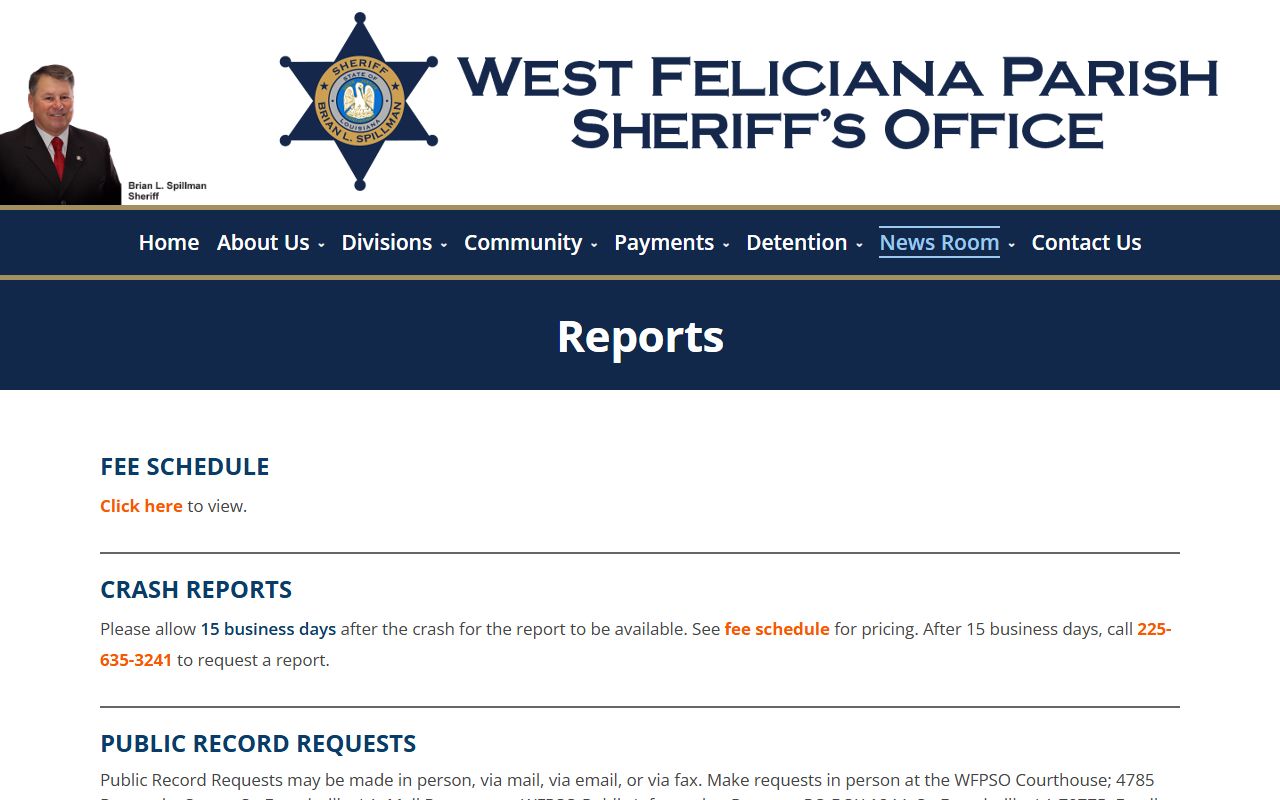
That request channel matters when the public booking page does not show the booking or report detail a requester needs.
Search West Feliciana Arrest Records
The search path depends on which side of the record is needed. For booking and custody, use the sheriff jail bookings page, the LAVNS/VINE link, Detention phone, or sheriff public-records request. For formal court charges after arrest, use the Clerk of Court and District Court case record once the prosecutor has filed the charging document.
- Check the sheriff jail bookings page for the booking date, name, age, address block, and charge text.
- Call Detention at 225-784-3158 when recent booking charges or custody status are not clear online.
- Use the Clerk of Court or court record once a bill of information, indictment, or other charging document has been filed.
- Review each charge separately because one arrest can lead to several counts with different statuses.
- Confirm the final outcome in the criminal court file, not just the booking entry.
Public records may also be requested from the sheriff in person at the WFPSO Courthouse, by mail to P.O. Box 1844, by email at records@wfpso.org, or by fax to 225-635-6947 attention RECORDS REQUEST.
Booking Records Before Court Charges
The sheriff jail bookings page is a public information service. The inspected fields included booking date, surname or name, age, address block or custody location, city and state, and charge text. Examples observed in the research included Domestic Abuse Battery / Pregnant Victim, Failure to Appear / Issuance of Arrest Warrant, Fugitive Warrant, Bench Warrant, Probation Violation, Operating a Vehicle while License is Suspended, DUI/OUI wording, Contempt of Court, Violation of Protective Order, and Battery of a Correctional Facility Employee.
The page did not show booking number, mugshot, date of birth, sex, race, height, weight, bond amount, court date, judge, pod, release date, arresting agency, or warrant number. That limited booking view should not be treated as a full criminal history or as proof of conviction.
The official bookings page is also assigned in the manifest. The sheriff Jail Bookings page is the local public list for recent custody entries.
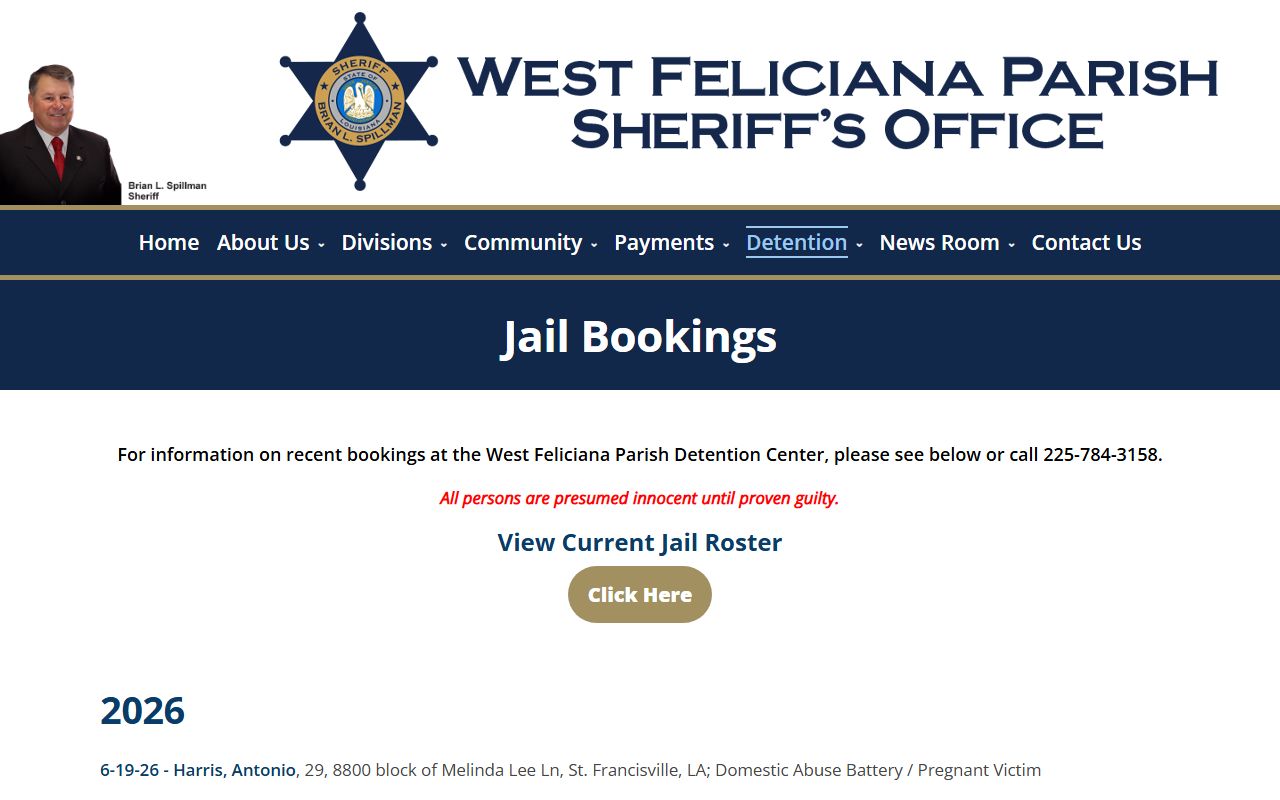
Its value is strongest at the arrest and custody stage, before the District Attorney's filed charges fully define the court case.
Charges After Arrest Documents
The District Attorney decides which formal prosecution charges will be filed. In West Feliciana Parish, the 20th Judicial District Attorney's Office serves East and West Feliciana Parishes. The West Feliciana office is at 11651 Ferdinand St. in St. Francisville and lists Assistant District Attorneys and a Traffic Coordinator. Once the DA files a bill of information, indictment, or other charging document, the charge becomes part of the court record.
| Document | Who Uses It | What It Does | West Feliciana Context |
|---|---|---|---|
| Complaint | Officer or prosecutor | Starts or supports a criminal accusation, often early in the process. | May relate to arrest paperwork before formal DA filing. |
| Bill of Information | District Attorney | Prosecutor's formal charging document in many Louisiana criminal cases. | Research identifies bills of information as filed with the Clerk. |
| Indictment | Grand jury | Grand jury charging document for serious matters. | Clerk receives indictments in criminal matters. |
The full case file and disposition belong in the criminal court record. The charge document is the accusation that frames the court case, while later minutes, pleas, judgments, and sentences explain what happened to each count.
District Attorney Charge Review
The 20th Judicial District Attorney is Samuel C. D'Aquilla. The West Feliciana office phone is 225-635-4612, and the listed office hours are 8:30 a.m.-4:30 p.m. Staff relevant to records and charges include Assistant District Attorneys assigned to West Feliciana Parish, an investigator/pre-trial diversion coordinator, a victim witness coordinator, and a Traffic Coordinator.
A sheriff booking charge is not the final court charge record. The DA may file the charge as booked, change the charge, add counts, reduce severity, decline prosecution, or dismiss a count later. Defendants should use counsel or the public defender for case-specific advice. The District 20 public defender office is listed at 4789 Prosperity Street, St. Francisville, with phone 225-304-4175.
The sheriff civil division also connects to criminal records and bonds. The West Feliciana Parish Sheriff's Office Civil Division page states that the office maintains criminal records files, processes criminal bonds, and handles court-mandated criminal fines and costs.
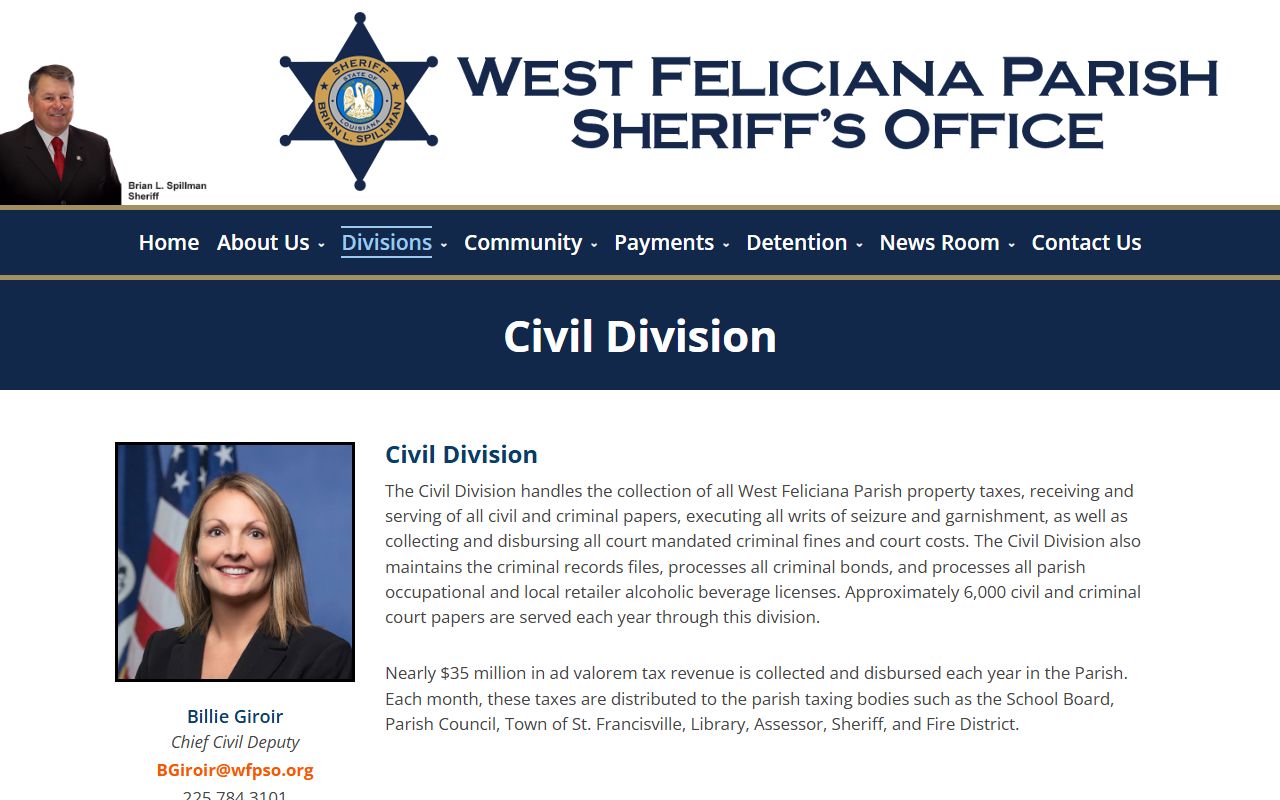
That sheriff role sits beside, not in place of, the prosecutor's charging decision and the Clerk's court-file record.
West Feliciana Charge Status
Charge status can change as the case moves. A count may be pending, amended, reduced, dismissed, or nolle prosequi. Nolle prosequi means the prosecutor has declined to proceed on that charge. A dismissal may occur for several reasons, including plea negotiation, lack of proof, diversion, procedural issues, or later court action.
| Status | What It Means | How to Read It |
|---|---|---|
| Pending | The charge is filed and not yet finally resolved. | Check future hearings and court minutes. |
| Amended | The filed charge was changed by prosecution or court action. | Compare the original count to the later count. |
| Reduced | The charge severity or offense was lowered. | Often appears with a plea or negotiated disposition. |
| Dismissed | The count or case was ended without conviction on that charge. | Confirm whether other counts remain. |
| Nolle Prosequi | The prosecutor declined to continue prosecution on that charge. | It is not the same as a conviction. |
| Guilty or not guilty | A plea or verdict status appears in the case record. | Use the final disposition and sentence to confirm outcome. |
Charges vs Convictions
Being charged is not the same as being convicted. A charge is an accusation filed in court. A conviction follows a guilty plea, guilty verdict, or other qualifying court outcome. One arrest may lead to no filed charge, one filed charge, several filed charges, dismissed counts, amended counts, or a final conviction on only part of the case.
| Point | Charge | Conviction |
|---|---|---|
| Stage | Accusation after arrest or prosecutor filing. | Final result after plea, verdict, or qualifying disposition. |
| Source | Booking entry, bill of information, indictment, or court minutes. | Judgment, minute entry, sentence, or final disposition. |
| Proof level | Based on arrest facts and prosecution decision. | Requires a guilty plea, verdict, or court finding. |
| Public effect | May appear in public booking or court records unless restricted. | May affect criminal history, sentencing, fines, and later expungement analysis. |
A charge label on the jail booking page should be read as the custody-stage label. For the full court outcome, use the criminal court record, case minutes, and final disposition.
Statewide Custody and Registry Checks
Statewide tools can help when local records do not answer the question. Louisiana VINE is the custody notification path listed in the research. Louisiana DOC says LAVNS supports searches by location, name, and ID or case number and can include people in DPS&C custody and supervision. VINE is not the same as a pre-arrest warrant database or a complete court-charge index.
The VINE source is part of the official custody path. The Louisiana VINE page is the statewide custody-notification source assigned to this page.

VINE helps with custody status, while the Clerk and District Court case file remain the stronger source for filed charges and court outcomes.
The Louisiana State Police sex offender registry is another state-level record system, but it has a narrower purpose. The Louisiana sex offender registry page covers registry information rather than ordinary arrest records.
Registry status should not be used as a substitute for reading the filed criminal case, charge status, and disposition.
Restricted West Feliciana Charge Records
Louisiana public-records law defines public records broadly, but criminal and law-enforcement files can have limits. Juvenile court records and reports are confidential under Louisiana Children's Code Article 412 except traffic violations and authorized disclosures. Adoption and certain sensitive court records are not public. Active-investigation material, victim-protective details, personal identifiers, sealed records, and expunged records may be withheld or redacted.
Louisiana Code of Criminal Procedure Article 971 says expungement removes qualifying records from public access but does not destroy them. Law-enforcement and defined agencies may still access expunged records. Local expungement costs from the Clerk criminal schedule include Clerk, District Attorney, Sheriff's Office, and State Police payments, subject to statutory exceptions and Article 983 cost limits.
Note: A dismissed, amended, sealed, or expunged charge can require direct court review because public search results may not tell the full story.